Disease background
Ulcerative Colitis is a chronic inflammatory bowel disease that affects the lining of the colon (large intestine) and rectum. In the United States, Ulcerative Colitis affects an estimated 400 out of every 100,000 people.
In people with Ulcerative Colitis, the inflammation usually begins in the rectum and may extend through part or all of the colon. Common symptoms include bowel urgency, diarrhea, rectal bleeding, and abdominal pain. Symptoms often come and go over time, with periods of active disease (flares) and periods when symptoms improve (remission).
Ulcerative Colitis is a long-term condition that can have a significant impact on daily life and overall quality of life. One of the most disruptive symptoms is bowel urgency, which is the sudden need to have a bowel movement that can be difficult to delay. Bowel urgency can greatly affect daily activities and it is a key focus of this study.
Therapeutic background
This research study is evaluating sacral neuromodulation (SNM), an investigational device-based treatment that delivers mild electrical stimulation to sacral nerves involved in bowel control. SNM does not involve taking additional study medication. The study does not include a placebo or sham group. Enrolled participants will receive active SNM treatment (implant) with the study device. The study site will explain medication-stability requirements and whether any medication changes are needed or permitted.
Who can participate?
- 18 to 85 years of age
- Diagnosed with Ulcerative Colitis
- Currently experiencing bowel urgency (the urgent need to go to the bathroom for bowel movement)
Locations
- Las Vegas, NV
- Los Angeles, CA
- Palo Alto, CA
- New York, NY
- Great Neck, NY
- Sioux Falls, SD
Reimbursement and compensation
If you are eligible and enroll in the study, compensation for your time and reimbursement for certain study-related out-of-pocket expenses may be available. The study site staff will explain what compensation and reimbursement are available. The study procedure and study-related care are provided at no cost to you.
Study description
The research study is evaluating the safety and effectiveness of an investigational device-based treatment for adults with Ulcerative Colitis who experience bowel urgency. If you are interested and appear to qualify for the study, the study site staff will provide a detailed overview of the steps involved before you decide whether to take part. They will also answer any questions and help you understand what participation would involve.
Taking part in this study is completely voluntary. You may choose to leave the study at any time, with or without giving a reason. Your decision will not affect your current or future medical care.
Screening and baseline visits
Before you can enroll in the study, you will complete a pre-screening assessment by phone to help determine whether the study may be a good fit for you. If you appear to qualify, your eligibility will be evaluated further at the study site. At the study site, the study team will explain the study in detail, answer any questions you may have, and ask you to review and sign an informed consent form before any study-specific procedures are performed. The study team will also review your medical history, assess your health status, and perform any required tests, including endoscopies (colonoscopy or sigmoidoscopy) and blood tests.
The procedure
The study is evaluating sacral neuromodulation (SNM), an investigational device therapy. In simple terms, the therapy sends gentle electrical signals to nerves that help control bowel function. During a minor procedure, a physician places a thin wire (called a lead) near the sacral nerves, which help control bowel function. The lead is connected to a small implanted device that delivers mild electrical signals intended to help reduce bowel urgency.
Study timeline
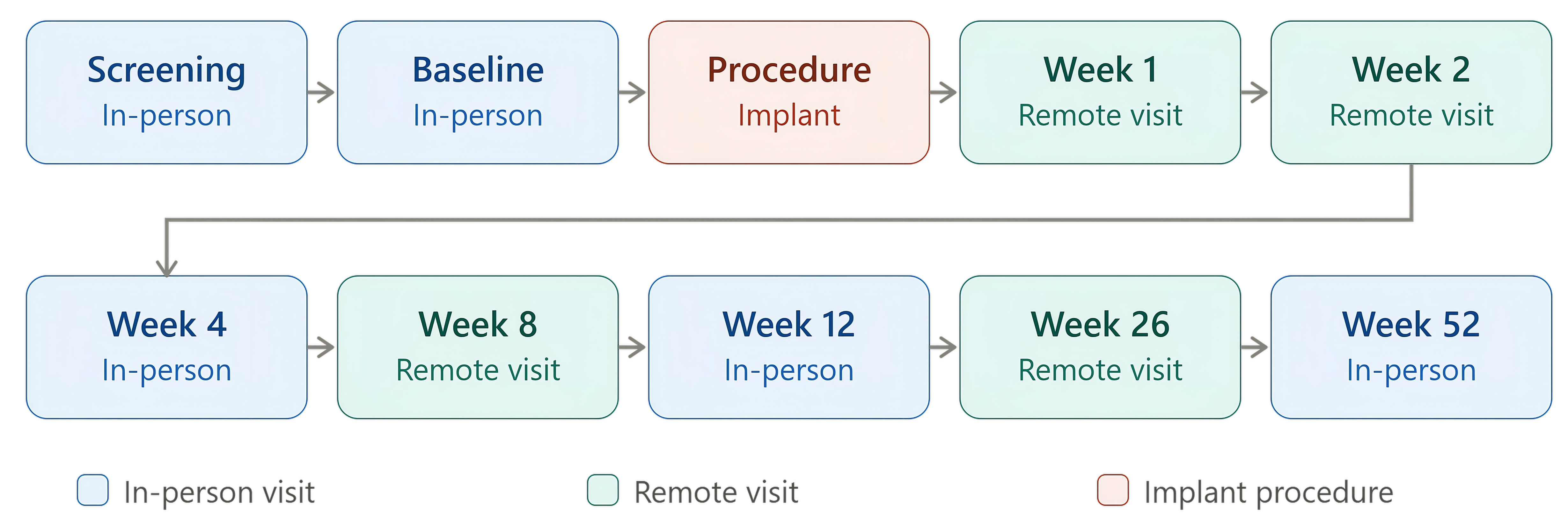
Participation lasts approximately 1 year and includes screening assessments, implantation of the sacral neuromodulation (SNM) device, and follow-up visits to monitor your symptoms, device performance, and overall health. Participants will complete approximately 10 scheduled study visits over 52 weeks, including a combination of in-person and remote visits.
Please see the study timeline illustrated below: